
BC Place World Cup 2026: NZ's Vancouver Venue — KICKOFF26
 Available in US
Loading...
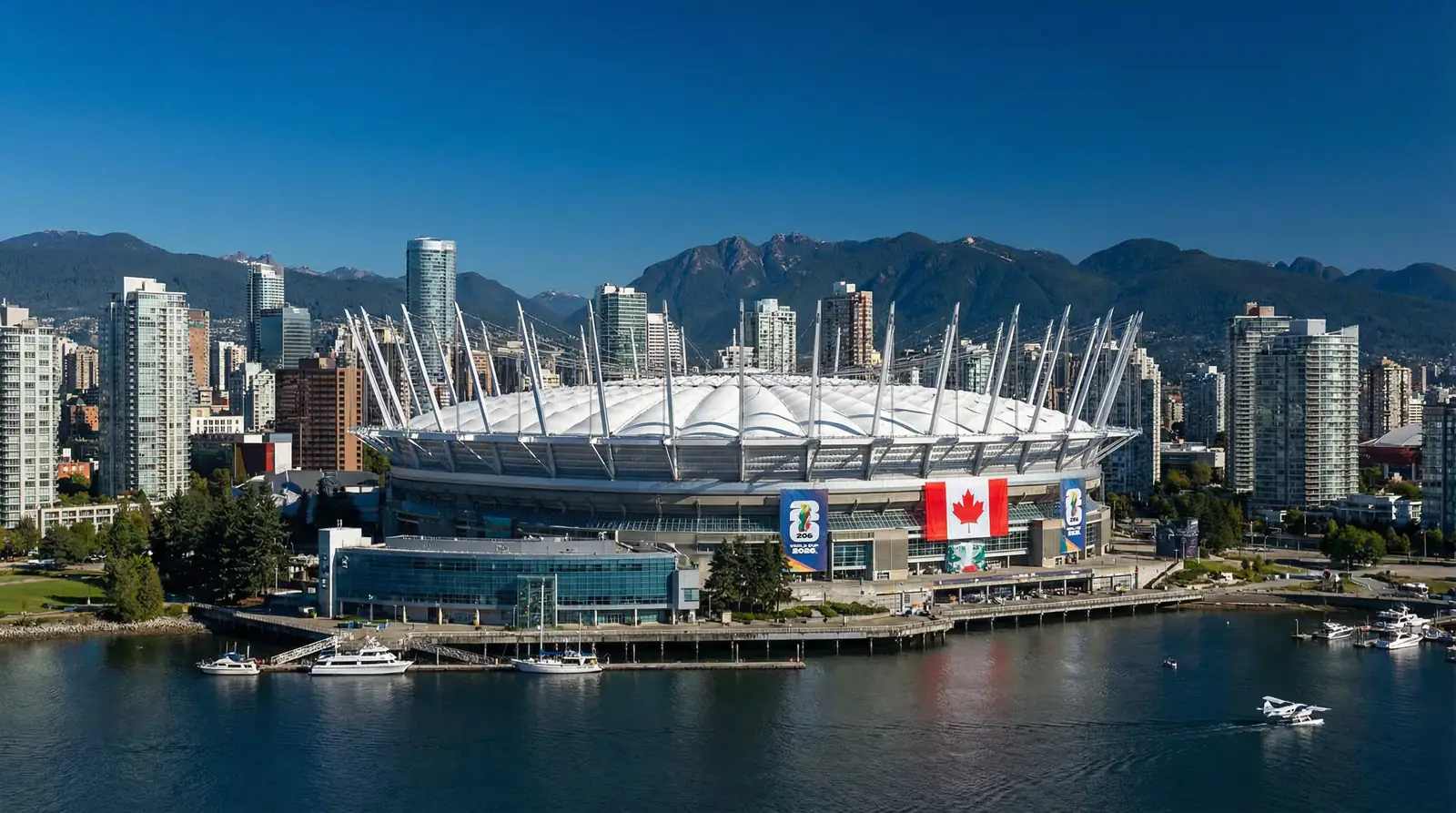
If there is a World Cup 2026 venue that feels like a second home for the All Whites, it is BC Place in Vancouver. Two of New Zealand’s three group-stage matches take place here — against Egypt on 22 June and Belgium on 27 June — and Vancouver’s combination of west-coast time zone, significant Kiwi diaspora, and proximity to the Pacific makes it the most geographically and culturally familiar North American city for a New Zealand squad. I have been studying BC Place’s specifications since the venue allocation was announced, and the data points toward a stadium that suits compact, organised teams — exactly the profile the All Whites will bring to the World Cup.
Venue Data: BC Place by the Numbers
Unlike SoFi Stadium’s US$5.5 billion extravagance, BC Place is a workhorse venue with decades of event history and a retractable roof that transforms it from open-air stadium to enclosed arena depending on conditions. Here is the statistical profile.
| Specification | Detail |
|---|---|
| Full name | BC Place Stadium |
| Location | Vancouver, British Columbia, Canada |
| Opened | June 1983 |
| Major renovation | 2011 (retractable roof installed) |
| WC football capacity | ~54,500 |
| Surface | Natural grass (temporary installation for WC) |
| Roof type | Retractable cable-supported fabric roof |
| Altitude | Sea level |
| Primary tenants | Vancouver Whitecaps (MLS), BC Lions (CFL) |
| Time zone | Pacific Time (PT) — UTC-7 in June |
The retractable roof is the feature that most affects playing conditions. Vancouver’s June weather is generally dry and mild — average highs of 20 degrees Celsius with occasional rain — but the option to close the roof ensures that World Cup matches proceed in controlled conditions regardless of weather. A closed roof amplifies crowd noise significantly, creating an atmosphere that players describe as more intense than open-air venues of similar size. For the All Whites, a closed-roof BC Place with 54,500 fans — many of them Kiwi supporters — could generate an environment that energises the underdog and unsettles opponents accustomed to larger but quieter venues.
BC Place’s capacity of 54,500 makes it one of the smaller World Cup 2026 venues — well below SoFi’s 70,000 or MetLife’s 82,500 — but the compact bowl design concentrates sound more effectively than sprawling open stadiums. The Vancouver Whitecaps regularly create impressive atmospheres for MLS matches with 22,000 fans; at full World Cup capacity, the volume increase is exponential rather than linear. The stadium’s location is also a logistical asset: it sits on False Creek in downtown Vancouver, within walking distance of the city’s main transit hub at Waterfront Station and surrounded by restaurants, hotels, and public spaces that will become de facto fan zones during the tournament. Unlike some World Cup venues located in suburban sprawl — MetLife Stadium in East Rutherford, for instance — BC Place is embedded in the urban fabric, which creates a match-day energy that starts hours before kickoff and extends long after the final whistle.
World Cup 2026 Matches at BC Place
As one of only two Canadian venues — alongside Toronto’s BMO Field — BC Place carries a substantial match allocation. Canada’s co-hosting status means Vancouver will host group-stage fixtures and potentially early knockout rounds.
| Date (ET) | Date (NZT) | Match | Stage |
|---|---|---|---|
| 21 Jun, 21:00 | 22 Jun, 13:00 | New Zealand vs Egypt | Group G |
| 26 Jun, 23:00 | 27 Jun, 15:00 | New Zealand vs Belgium | Group G |
| TBC | TBC | Additional group/knockout matches | Various |
Both New Zealand matches at BC Place kick off at convenient NZT times: 13:00 on 22 June (vs Egypt) and 15:00 on 27 June (vs Belgium). The Egypt match falls on a Monday NZT, the Belgium match on a Saturday NZT — and that Saturday afternoon timeslot for the final group match is about as good as it gets for Kiwi viewing parties. I expect the Belgium match, in particular, to draw the largest New Zealand television audience for a football match since the 2010 Italy game.
All Whites at BC Place: Egypt and Belgium
The matchday-two fixture against Egypt on 22 June is the match I have identified as the All Whites’ most winnable contest in the group — and therefore the most important 90 minutes of the entire campaign. By that point, New Zealand will have played Iran at SoFi Stadium five days earlier, and the result of that opening match will determine whether the Egypt fixture is about building on a platform or salvaging a campaign.
Egypt will arrive at BC Place having already faced Belgium on matchday one. If Belgium have beaten Egypt — which my model rates as the likeliest outcome at 52% — then Egypt will be under pressure to win their second match, which could lead to a more open game than the tactical stalemate New Zealand would prefer. Conversely, if Egypt drew with Belgium, they may approach the New Zealand match more cautiously, content with a point that keeps their qualification hopes alive. From a tactical standpoint, I expect the All Whites to set up in a compact mid-block, concede territory to Egypt’s more technical midfield, and look to exploit transitions — the same approach that earned three draws in 2010.
The Belgium match on 27 June is the group finale, and the permutations are vast. If Belgium have already secured first place — a likely scenario after two matches — they may rotate their squad, bringing in fringe players and resting De Bruyne and Doku for the knockout stage. A rotated Belgium side is still strong, but the gap between their first XI and their reserves is wider than for squads like France or England. For New Zealand, facing a Belgium side already through to the knockouts is the best possible scenario: it turns the match from a 15-20% draw probability into something closer to 25-30%.
The atmosphere at BC Place for that final match will be extraordinary. It is the last group-stage fixture for both sides, played simultaneously with Egypt-Iran in Seattle, and the stakes for New Zealand could range from “playing for pride” to “a win puts us through.” Vancouver’s Kiwi community, combined with travelling fans who will have been in North America for nearly two weeks by that point, should produce a wall of green-and-white support. In 2010, the All Whites’ three draws were achieved with minimal travelling support in South Africa; in Vancouver, the fan factor could be genuinely decisive in creating the kind of hostile environment that disrupts favoured opponents.
Vancouver: City Context for NZ Fans
Vancouver is, by a considerable margin, the most Kiwi-friendly city in North America. The city sits on the Pacific coast, faces west toward New Zealand across the ocean, and hosts an estimated 8,000-10,000 New Zealand-born residents — the largest Kiwi community in Canada. Direct flights from Auckland to Vancouver run approximately 13 hours, and the cultural overlap between the two countries — outdoor lifestyle, coffee culture, proximity to mountains and water — makes Vancouver a natural fit for travelling fans.
June is Vancouver’s best month. Average temperatures sit between 14 and 21 degrees Celsius, rainfall is minimal, and the days are extraordinarily long — sunset does not arrive until after 21:00 local time. For Kiwi fans arriving from winter in New Zealand, Vancouver in June offers an extended-daylight welcome that makes jet lag more manageable. The city’s craft beer scene — over 40 breweries within the metro area — rivals any in North America, and the seafood is outstanding. The city’s Gastown, Yaletown, and Commercial Drive neighbourhoods all have concentrations of bars and restaurants that will screen World Cup matches, and the walk from downtown Vancouver to BC Place takes under 15 minutes along False Creek’s waterfront.
The time difference between Vancouver and New Zealand is 19 hours in June (NZST is UTC+12, PDT is UTC-7). When the All Whites kick off at 18:00 local time in Vancouver on 21 June, it is 13:00 on 22 June in New Zealand. That split-date effect — where the match happens on a different calendar day depending on which side of the Pacific you are watching from — is worth keeping in mind when discussing fixtures with fans in different time zones. For travelling fans already in Vancouver, the local kickoff times of 18:00 and 20:00 are ideal evening appointments that allow a full day of sightseeing before heading to BC Place. For a complete breakdown of the All Whites’ tactical approach and squad data, the team profile page covers every angle a Kiwi punter needs.
