
Estadio Azteca: World Cup 2026 Opening Match Venue — KICKOFF26
 Available in US
Loading...
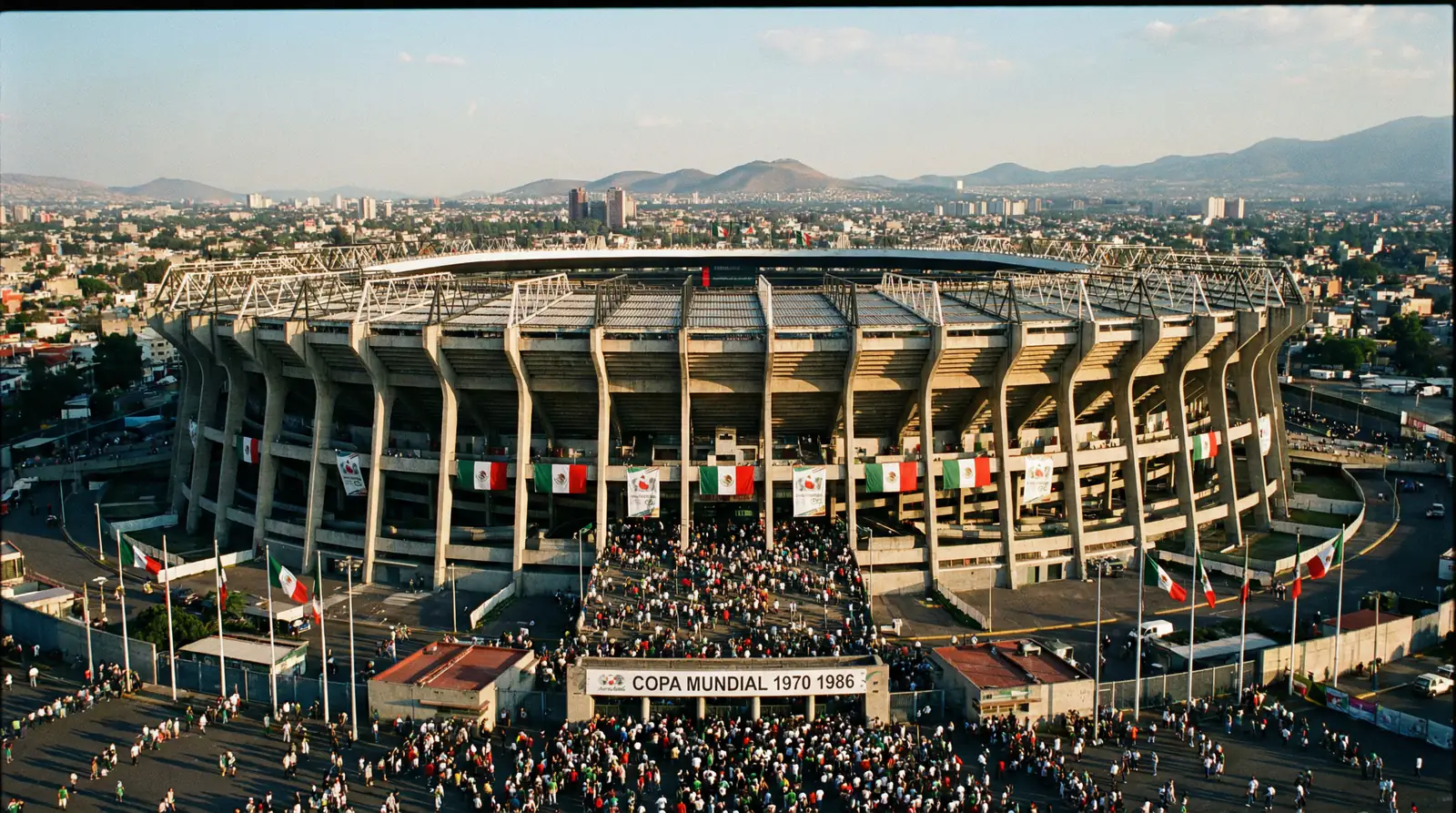
No stadium in world football carries more World Cup history than Estadio Azteca. Pele lifted the Jules Rimet trophy here in 1970. Maradona scored the “Goal of the Century” here in 1986 — the same match that produced the “Hand of God.” On 11 June 2026, Estadio Azteca becomes the first venue in history to host three FIFA World Cups when Mexico face South Africa in the tournament’s opening match. I have visited the Azteca twice — once during the 2016 Copa America Centenario and once for a Mexico qualifier in 2024 — and the atmosphere is unlike anything I have encountered in nine years of covering international football. The stadium breathes, and for the opening match of the biggest World Cup ever held, that breath will be heard across the planet.
Three World Cups: The Azteca’s Unique History
Most World Cup venues host a handful of matches across a single tournament and then return to domestic duty. Estadio Azteca has hosted two World Cup finals, multiple semi-finals, and dozens of group-stage matches across 1970 and 1986. That legacy is not just historical decoration — it directly shapes the matchday experience and the psychological weight that visiting teams carry into the stadium.
In 1970, the Azteca witnessed what many historians consider the greatest World Cup of all time. Brazil’s 4-1 victory over Italy in the final — featuring goals from Pele, Gerson, Jairzinho, and Carlos Alberto — is the standard against which all subsequent World Cup finals are measured. The stadium held 107,000 for that match, a number that modern safety regulations will not permit but that illustrates the scale of what the Azteca was built to contain.
In 1986, the Azteca hosted two of the most famous moments in football history within the same quarter-final. Maradona’s “Hand of God” goal against England — a deliberate handball that the referee missed — was followed four minutes later by his extraordinary solo dribble past five English defenders, a goal voted the greatest in World Cup history in multiple FIFA polls. The stadium witnessed both sporting villainy and sporting genius in the space of 240 seconds, and that duality defines the Azteca’s character: it is a venue where the extraordinary becomes routine.
The 2026 tournament adds a third chapter. Estadio Azteca will not host the final this time — that honour goes to MetLife Stadium in New Jersey — but the opening match carries its own symbolic weight. FIFA’s decision to stage the tournament’s first kick at the Azteca is a deliberate nod to the venue’s unmatched history, and the match between co-hosts Mexico and South Africa on 11 June 2026 will set the tone for everything that follows across 39 days and 104 matches. No other stadium in any sport can claim to have hosted the opening match of three separate editions of the world’s most-watched event. The Maracana in Rio has hosted two World Cup finals (1950 and 2014) but never three full tournaments. Wembley has hosted one. The Azteca stands alone.
Venue Data: Estadio Azteca by the Numbers
The Azteca has undergone significant renovation in preparation for 2026, but its core dimensions and character remain rooted in its 1966 construction.
| Specification | Detail |
|---|---|
| Full name | Estadio Azteca (Estadio Guillermo Canedo) |
| Location | Coyoacan, Mexico City, Mexico |
| Opened | May 1966 |
| Major renovations | 1986, 1999, 2016, 2024-2025 (for WC 2026) |
| WC football capacity | ~87,500 |
| Surface | Natural grass (permanent) |
| Roof type | Open-air (partial cover over upper tiers) |
| Altitude | 2,240 metres above sea level |
| Primary tenant | Club America (Liga MX) |
| Time zone | Central Time (CT) — UTC-5 in June |
The altitude of 2,240 metres is the single most important data point for any match played at the Azteca. At that elevation, the air contains approximately 20% less oxygen than at sea level. Visiting teams from low-altitude nations — virtually every European, Oceanian, and most Asian sides — experience measurable aerobic decline within the first 30 minutes, with effects compounding in the second half. Research published in the British Journal of Sports Medicine found that teams playing above 2,000 metres scored 0.3 fewer goals per match on average compared to sea-level games, and the visiting team’s disadvantage was amplified to 0.5 goals per match. Mexico, whose players train and compete at altitude throughout their domestic season, suffer no such deficit.
The natural grass surface is a significant advantage over the temporary installations at US venues. The Azteca’s pitch is permanent, maintained year-round by Club America’s groundskeeping staff, and will be in match-ready condition for the tournament without the teething problems that come with modular grass systems. Players consistently rate the Azteca surface among the best in the Americas — it is softer and more responsive than the firm temporary surfaces at SoFi or MetLife.
World Cup 2026 Matches at Estadio Azteca
The Azteca hosts a selection of group-stage matches as part of Mexico’s 13-match allocation across three venues (Azteca, Monterrey, Guadalajara).
| Date (ET) | Date (NZT) | Match | Stage |
|---|---|---|---|
| 11 Jun, 19:00 ET | 12 Jun, 11:00 NZT | Mexico vs South Africa | Opening Match (Group A) |
| Various | Various | Additional group matches | Group stage |
The opening match — Mexico vs South Africa — kicks off at 19:00 ET on 11 June, which is 11:00 NZT on 12 June. For Kiwi viewers, that is a late-morning Thursday start, perfectly timed for a work-from-home viewing session or an extended lunch break. The fixture carries emotional resonance beyond the football: Mexico and South Africa opened the 2010 World Cup in identical fashion, with a 1-1 draw at Soccer City in Johannesburg. A repeat in Mexico City, 16 years later, in the first three-host World Cup, would be a narrative that writes itself. The altitude advantage for Mexico is substantial in this specific fixture — South Africa’s domestic league plays at various altitudes (Johannesburg sits at 1,753 metres), which gives them partial acclimatisation, but the additional 500 metres of the Azteca makes a measurable difference in the second half. My model gives Mexico a 58% win probability for this opener, with a draw at 24% and a South Africa win at 18%.
Mexico City: Context and Altitude Warning
Mexico City is one of the largest urban areas on earth, with a metropolitan population exceeding 21 million people. The city’s altitude is the defining characteristic for any sporting event held here: at 2,240 metres, it sits higher than Denver (1,609 m), Johannesburg (1,753 m), and Bogota (2,640 m is higher, but Mexico City’s combined altitude and air quality create unique challenges). Air pollution has historically been a concern, though the city’s air quality has improved substantially over the past two decades due to industrial regulation and vehicle emission controls.
For New Zealand fans considering travel to Mexico City for the opening ceremony and match, the altitude requires acclimatisation. Medical guidance suggests arriving at least 48 hours before exposure to physical exertion at altitude, and staying hydrated is essential — the combination of altitude and mild dehydration from long-haul travel can cause headaches and fatigue that mimic severe jet lag. The temperature in Mexico City in June averages 18-26 degrees Celsius — remarkably mild for a city at this latitude — and afternoon rain showers are common during the June rainy season. The rain typically arrives in short, intense bursts between 15:00 and 18:00 local time, clearing by evening. The cultural experience of Mexico City — its food, museums, architecture, and street life — makes it one of the most rewarding World Cup destinations for fans willing to make the journey. The city’s Condesa and Roma neighbourhoods offer world-class dining and accommodation within easy reach of the Azteca.
Estadio Azteca is connected to Mexico City’s metro system via the Tasquena line, and the journey from the historic city centre (Zocalo) takes approximately 40 minutes. On match days, dedicated bus services supplement the metro, and the approach to the stadium through the surrounding neighbourhood — filled with food vendors, merchandise stalls, and street musicians — is a matchday experience that has no equivalent at the sterile suburban US venues. The sensory overload of arriving at the Azteca on a match day is something every football fan should experience at least once. For those following the tournament from New Zealand, the Group A preview covers Mexico’s chances and the full opening-round schedule in NZT.
