
SoFi Stadium World Cup 2026: NZ Venue Guide — KICKOFF26
 Available in US
Loading...
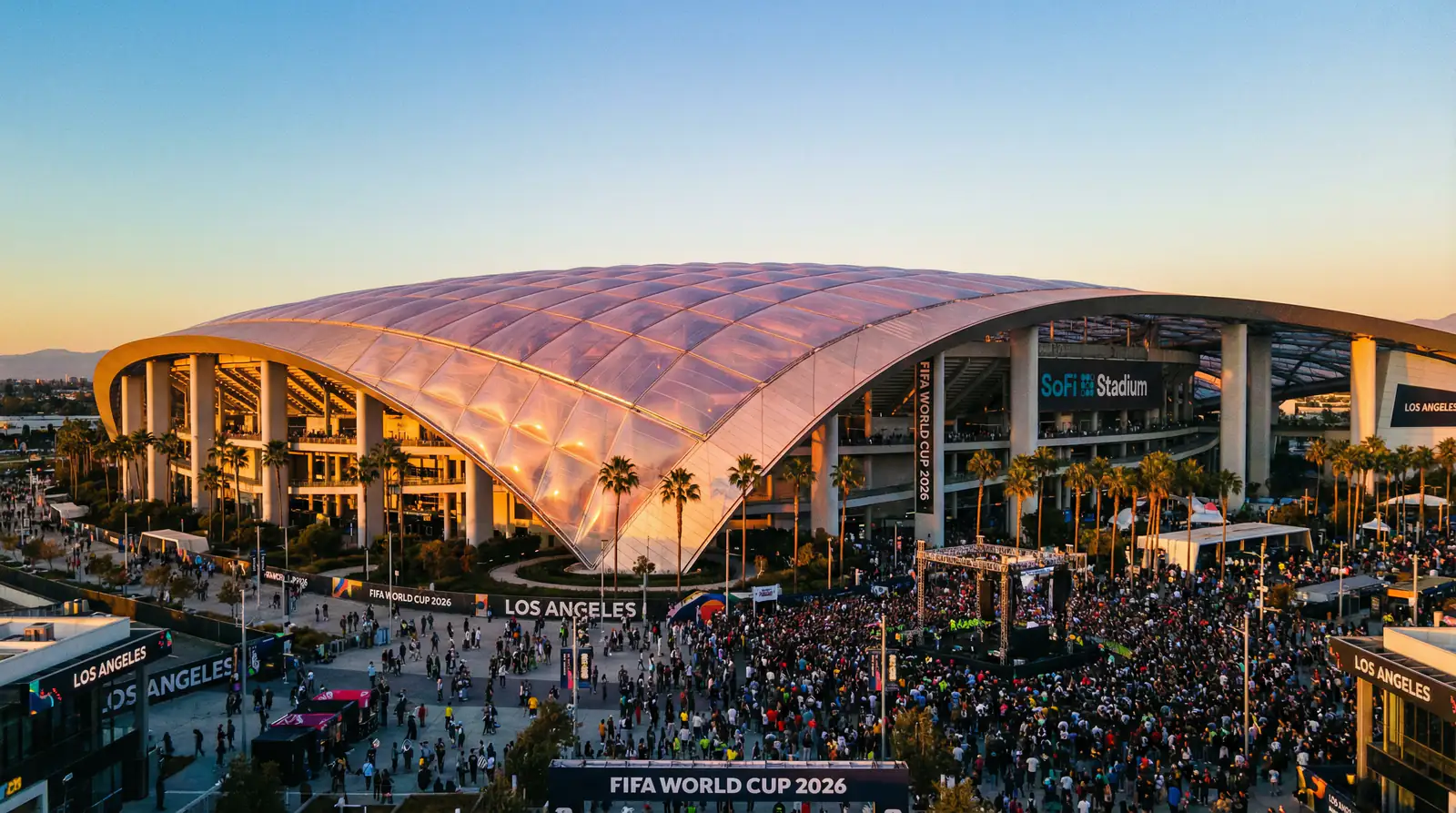
When the All Whites step onto the pitch for their opening World Cup 2026 match on 16 June, the venue surrounding them will be the most expensive sports facility ever built on the planet. SoFi Stadium in Inglewood, California — just south of downtown Los Angeles — cost US$5.5 billion to construct, seats over 70,000 for football configuration, and features a translucent canopy roof that shelters the field from California’s sun while keeping the air open. For New Zealand, this is where the 2026 World Cup begins: Iran versus New Zealand, 13:00 NZT, in a stadium that did not exist the last time the All Whites played at a World Cup.
Venue Data: SoFi Stadium by the Numbers
I track venue data for every World Cup stadium because the physical environment affects match outcomes in measurable ways — temperature, altitude, surface, and crowd capacity all feed into my models. SoFi Stadium’s numbers tell a story of modern excess and engineering ambition.
| Specification | Detail |
|---|---|
| Full name | SoFi Stadium (Los Angeles Stadium at Hollywood Park) |
| Location | Inglewood, California, USA |
| Opened | September 2020 |
| Construction cost | US$5.5 billion |
| WC football capacity | ~70,240 |
| Maximum capacity | 100,240 (concerts/events) |
| Surface | Natural grass (installed for WC; normally synthetic) |
| Roof type | Fixed ETFE canopy (open-air, not enclosed) |
| Altitude | 30 metres above sea level |
| Primary tenants | LA Rams (NFL), LA Chargers (NFL) |
| Time zone | Pacific Time (PT) — UTC-7 in June |
The surface conversion deserves attention. SoFi Stadium’s normal playing surface is synthetic turf optimised for American football. For the World Cup, FIFA requires natural grass, and a temporary grass surface will be installed — a process that has occasionally caused problems at previous tournaments. The 2022 World Cup in Qatar used a similar approach at some venues with mixed results, and players have reported that temporary grass surfaces can feel slower and less responsive than permanent installations. For a team like New Zealand that trains predominantly on natural grass, this is a marginal positive — CONMEBOL teams accustomed to varied surface quality may adapt faster, but the All Whites will not be disadvantaged by the transition.
SoFi’s open-air canopy design means the stadium is not fully enclosed. June temperatures in Inglewood average 22-26 degrees Celsius with low humidity — comfortable playing conditions that will not fatigue either side. The altitude of 30 metres above sea level is negligible, unlike Mexico City’s 2,240-metre elevation which measurably affects aerobic performance. In short, SoFi Stadium offers a neutral, modern, climate-controlled environment where the match will be decided on footballing quality rather than environmental factors.
World Cup 2026 Matches at SoFi Stadium
FIFA has allocated a significant slate of matches to SoFi Stadium, reflecting its status as the largest and most expensive venue in the tournament. The full match schedule includes group-stage fixtures and at least one knockout round.
| Date (ET) | Date (NZT) | Match | Stage |
|---|---|---|---|
| 15 Jun, 21:00 | 16 Jun, 13:00 | Iran* vs New Zealand | Group G |
| 21 Jun, 15:00 | 22 Jun, 07:00 | Belgium vs Iran* | Group G |
| TBC | TBC | Additional group matches | Group stage |
| TBC | TBC | Knockout fixture(s) | Round of 32 / R16 |
The New Zealand match on 16 June at 13:00 NZT is the headline fixture for Kiwi audiences. That timeslot — a Monday lunchtime in New Zealand — is ideal for viewing. Pubs, offices, and living rooms across the country will be tuned in for what is arguably the most significant match in All Whites history since the 2010 draw with Italy. The second SoFi fixture involving Group G teams — Belgium vs Iran on 22 June — kicks off at 07:00 NZT, an early-morning start but still watchable for committed fans who want to see how the group is unfolding.
Stadium Features and Specifications
I have visited dozens of football stadiums across four continents in my career, and SoFi is a different animal entirely. The ETFE (ethylene tetrafluoroethylene) canopy that arches over the stadium is a single continuous structure spanning 3.1 million square feet — the largest such membrane roof in the world. It filters natural light onto the pitch while blocking direct sun, creating playing conditions that are bright without the glare that can affect visibility for players tracking high balls. The curved structure also channels Pacific breezes across the field, keeping air circulating in a way that fully enclosed domed stadiums cannot achieve.
The videoboard — a double-sided, 70,000-square-foot LED screen suspended from the canopy — is the largest in any sports venue globally. For World Cup matches, this screen will display real-time statistics, VAR replay angles, and group-standing updates that keep the crowd informed and engaged. The acoustic design of the stadium amplifies crowd noise effectively despite the open-air design; NFL games at SoFi regularly exceed 100 decibels, and a 70,000-strong World Cup crowd should produce an atmosphere that rivals traditional European football stadiums.
From an accessibility standpoint, SoFi Stadium meets FIFA’s Category 4 venue requirements with extensive wheelchair seating, accessible concourses, and sensory rooms. The concourse areas are wide enough to handle the flow of 70,000 spectators without the bottlenecks that plague older venues, and the food and beverage infrastructure can serve the entire stadium within a 15-minute half-time window — a logistical detail that sounds trivial until you have spent a World Cup half-time in a queue stretching 200 metres.
All Whites at SoFi: The Opening Match
I keep a file on every All Whites match I have analysed over the past nine years, and the Iran-New Zealand fixture is unlike anything in that archive. It is the first time New Zealand play a competitive World Cup match on North American soil. It is the first All Whites World Cup appearance in 16 years. And it comes with an asterisk of geopolitical uncertainty surrounding Iran that could reshape the match entirely if Iran withdraw or are replaced.
Assuming Iran participate, this is a match where defensive discipline will define the outcome. Iran’s World Cup record is built on absorbing pressure and striking on the counter — they held Portugal to a 1-1 draw in 2018 and nearly forced a result against Spain in the same tournament. New Zealand’s 2010 template — three draws from three matches, including a 1-1 result against reigning world champions Italy — is the tactical reference point. A low-scoring, cagey match with both sides prioritising structure over adventure is my baseline expectation.
SoFi’s 70,000 capacity will be split between Iranian diaspora (Los Angeles has one of the largest Iranian communities outside Iran), Kiwi fans, and neutral American spectators. The atmosphere will be unlike anything most All Whites players have experienced — louder, larger, and more intense than any OFC qualifier or A-League match. How the squad handles that sensory overload in the opening 15 minutes will tell us a great deal about their tournament readiness.
Los Angeles: City Context for NZ Supporters
For the thousands of New Zealand fans planning to travel to the World Cup, Los Angeles is one of the more accessible US cities from Auckland. Direct flights from Auckland to LAX run approximately 12 hours, and the route is served by multiple airlines with high frequency. The time difference between NZST and Pacific Time in June is 19 hours — when it is 13:00 in New Zealand on 16 June, it is 18:00 on 15 June in Los Angeles. That can be disorienting, but the practical effect is that Kiwi fans arrive in LA with most of the day ahead of them after an overnight flight.
June weather in Los Angeles is dry and warm — average highs of 26 degrees Celsius with virtually no rainfall. The marine layer (coastal fog) often keeps mornings cool before burning off by midday. For New Zealanders arriving from a southern-hemisphere winter, the temperature shift is significant but not extreme. SoFi Stadium is located in Inglewood, approximately 5 kilometres from LAX, making it one of the most airport-accessible World Cup venues. Public transport via the LA Metro K Line connects the stadium area to the wider city, though Los Angeles remains a car-dependent city by New Zealand standards.
The broader Kiwi diaspora in southern California — estimated at over 15,000 permanent residents — will likely provide a base of local support for the All Whites. Combined with travelling fans, I expect a noticeable green-and-white presence at SoFi on 16 June. For a detailed breakdown of the All Whites’ full World Cup 2026 campaign, including squad analysis and Group G odds, the team profile covers everything a Kiwi punter needs before placing a matchday-one bet.
