
MetLife Stadium: World Cup 2026 Final Venue Guide — KICKOFF26
 Available in US
Loading...
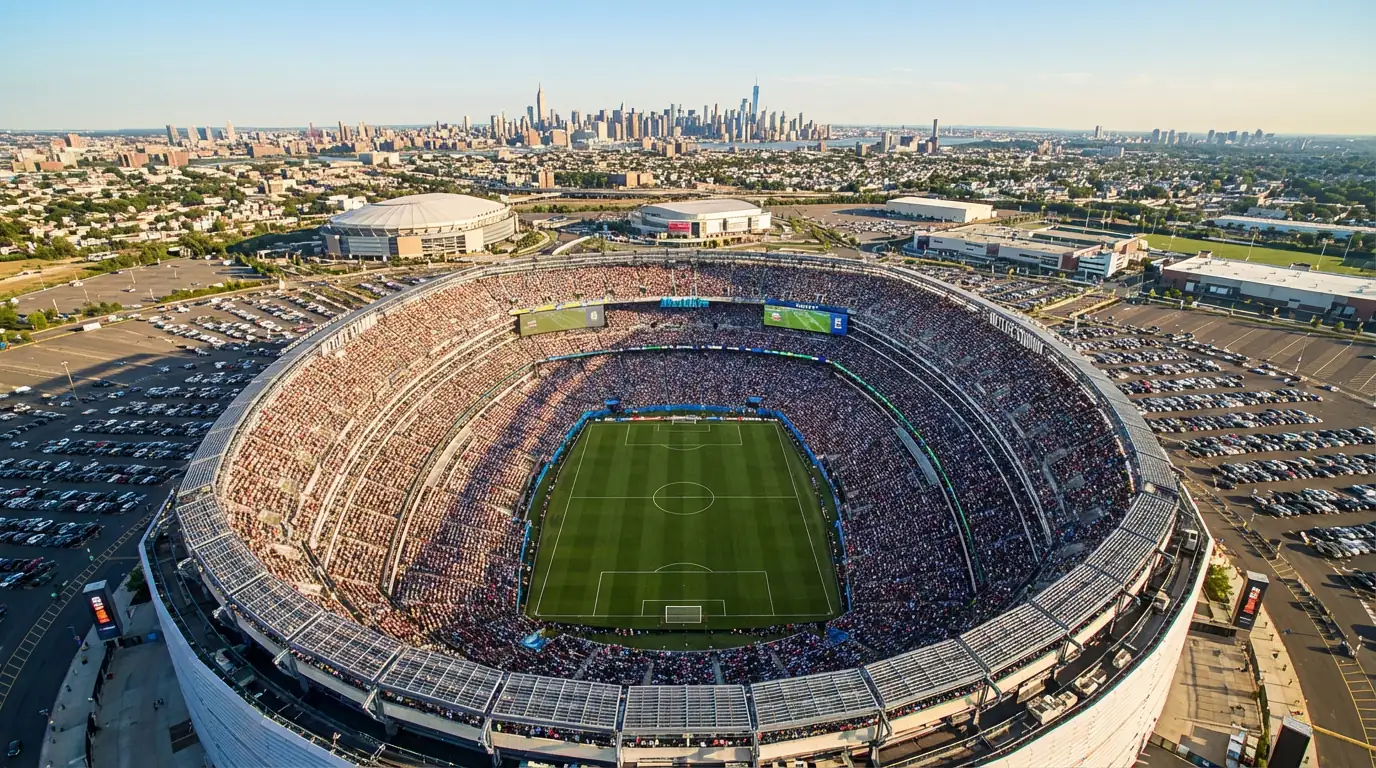
On 19 July 2026, the final of the FIFA World Cup will be played at MetLife Stadium in East Rutherford, New Jersey — a venue that sits in the shadow of the Manhattan skyline, across the Hudson River from the most famous city on earth. I have always believed that a World Cup final venue shapes the narrative of an entire tournament, and MetLife’s combination of massive capacity, New York proximity, and open-air design will create a setting unlike anything in recent World Cup memory. This is the stadium where a champion will be crowned, and every group-stage match, every knockout-round bet, every outright wager converges on this single venue on a single night in July.
Venue Data: MetLife Stadium by the Numbers
MetLife is not glamorous. It lacks SoFi’s architectural ambition and BC Place’s downtown waterfront setting. What it offers is scale, infrastructure, and proximity to the largest metropolitan area in North America — and at a World Cup, those factors matter more than aesthetics.
| Specification | Detail |
|---|---|
| Full name | MetLife Stadium |
| Location | East Rutherford, New Jersey, USA |
| Opened | April 2010 |
| Construction cost | US$1.6 billion |
| WC football capacity | ~82,500 |
| Surface | Natural grass (temporary for WC) |
| Roof type | Open-air (no roof) |
| Altitude | Sea level |
| Primary tenants | NY Giants (NFL), NY Jets (NFL) |
| Time zone | Eastern Time (ET) — UTC-4 in July |
The 82,500 capacity makes MetLife the largest World Cup 2026 venue and the setting for the tournament’s biggest occasions. The open-air design is the most notable specification for football purposes: July weather in the New York metropolitan area averages 30 degrees Celsius with high humidity, creating demanding physical conditions for a World Cup final. The last open-air World Cup final in comparable heat was the 1994 final at the Rose Bowl in Pasadena, where Brazil beat Italy on penalties after a 0-0 draw — a match widely remembered for the oppressive Californian sun that sapped both teams’ energy. MetLife’s New Jersey humidity adds a dimension that dry Californian heat does not, and I factor this into my models when projecting knockout-stage outcomes at this venue.
The grass surface is another variable. MetLife Stadium normally uses synthetic turf for its NFL tenants, and the temporary natural grass installation for the World Cup has been a subject of FIFA scrutiny since the venue was confirmed. A test event in 2025 yielded mixed player feedback — the surface was described as firm and slightly uneven in some areas — and FIFA has invested in an upgraded installation system for 2026. The grass will be grown off-site in modular trays and installed in the weeks before the tournament, a technique pioneered at Euro 2024 in Germany with generally positive results. For teams that rely on quick, short passing combinations (Spain, Germany, Japan), a firm surface accelerates the ball and benefits their style. For teams that prefer a slower, more physical game (Paraguay, Iran), the surface is a marginal disadvantage. By the time the final arrives in mid-July, the grass will have endured six weeks of matches and summer heat, and its condition in the decisive fixture will depend heavily on FIFA’s pitch management protocols.
World Cup Matches at MetLife Stadium
As the final venue, MetLife hosts the tournament’s crown jewel plus a selection of group-stage and knockout matches. The full allocation reflects its status as the centrepiece of the US venue network.
| Date (ET) | Date (NZT) | Match | Stage |
|---|---|---|---|
| Various | Various | Group stage matches (4-6 fixtures) | Group stage |
| TBC | TBC | Round of 32 / Round of 16 | Knockout |
| TBC | TBC | Quarter-final | Knockout |
| 15 Jul | 16 Jul | Semi-final | Knockout |
| 19 Jul, 16:00 ET | 20 Jul, 08:00 NZT | WORLD CUP FINAL | Final |
The final kicks off at 16:00 ET on 19 July, which translates to 08:00 NZT on Sunday 20 July. That is an early-morning start for New Zealand, but for the World Cup final, few Kiwi fans will complain about setting an alarm. The timing is actually favourable compared to European-hosted tournaments: the 2022 final in Qatar kicked off at 02:00 NZT, and the 2018 final in Russia at 01:00 NZT. An 08:00 Sunday morning final is civilised by comparison.
The Final: 19 July 2026 at MetLife Stadium
World Cup finals carry a weight that no other sporting event replicates. I have covered four — 2010, 2014, 2018, 2022 — and the atmosphere in the venue is unlike anything in club football or domestic sport. MetLife’s 82,500 seats will be filled with a mix of national fan groups, corporate hospitality, FIFA delegates, and neutral spectators, creating a cacophony that players describe as both deafening and disorienting.
The historical data on World Cup finals is rich with patterns. Since 1990, finals have produced an average of 2.1 goals per match, with four of the eight finals going to extra time or penalties. Defensive discipline, squad depth, and penalty-shootout preparation are the three factors that my model weights most heavily at the final stage — and all three favour European teams, which have won five of the last eight finals. My bracket model projects France vs England as the most probable final pairing at 4.2% combined probability, followed by France vs Brazil at 3.8% and Argentina vs England at 3.1%. The most likely champion — as I detail in my knockout stage predictions — is France, though the margins at this stage of the tournament are razor-thin.
For punters, the final represents the culmination of every outright, reaching-the-final, and correct-score bet placed months earlier. The key strategic insight I offer is this: back your outright winner before the group stage begins, when odds are at their longest. By the time the semi-finalists are known, the market will have compressed dramatically, and the value evaporates. MetLife Stadium on 19 July is where those pre-tournament positions pay off — or do not.
One more data point worth noting: the 1994 World Cup final at the Rose Bowl — the last time a World Cup final was played in the United States — drew a crowd of 94,194 and television audiences that broke records in over 140 countries. MetLife’s 82,500 capacity is smaller, but the global broadcast infrastructure has expanded enormously in the intervening three decades. FIFA projects the 2026 final will reach a cumulative television audience exceeding 1.5 billion viewers worldwide, making it the most-watched sporting event in history. For New Zealand, the 08:00 Sunday NZT kickoff is prime weekend-morning viewing — the kind of appointment television that brings a country to a standstill regardless of who is playing.
New York / New Jersey: Context for Travelling Fans
MetLife Stadium is technically in New Jersey, not New York City, though the distinction is largely administrative. The stadium sits in the Meadowlands Sports Complex, approximately 12 kilometres west of Midtown Manhattan. Access from New York City is via NJ Transit trains and buses, with a dedicated Meadowlands Rail Line running on event days. The journey from Penn Station in Manhattan to MetLife takes approximately 30 minutes — faster than reaching many London Premier League grounds from central London.
July in the New York area is hot and humid. Average highs reach 30-32 degrees Celsius with humidity levels that feel tropical to visitors from temperate climates. For New Zealand fans accustomed to mild winter temperatures in July (Wellington averages 9 degrees Celsius in July), the temperature swing is dramatic — a 22-degree difference that demands acclimatisation. Light clothing, hydration, and sun protection are essential for anyone attending matches at MetLife during the day. Air-conditioned transport between Manhattan and the stadium is available on NJ Transit, which helps, but the walk from the station to the MetLife gates is approximately 10 minutes in open air without shade.
The broader New York metropolitan area — 20 million people across New York, New Jersey, and Connecticut — is the largest urban agglomeration in North America and one of the most diverse cities on earth. Every participating nation will have a diaspora community in the New York area, which means every match at MetLife will feel like a genuine two-sided contest in the stands. That diversity of support is one of the unique selling points of an American World Cup: the host nation provides not just venues but ready-made fan bases for nearly every competing team. For the final, neutral tickets will be the most sought-after commodity in world sport, with secondary market prices already projected to exceed NZ$5,000 for lower-bowl seats.
