
World Cup History & Stats: Complete Data Archive — KICKOFF26
 Available in US
Loading...
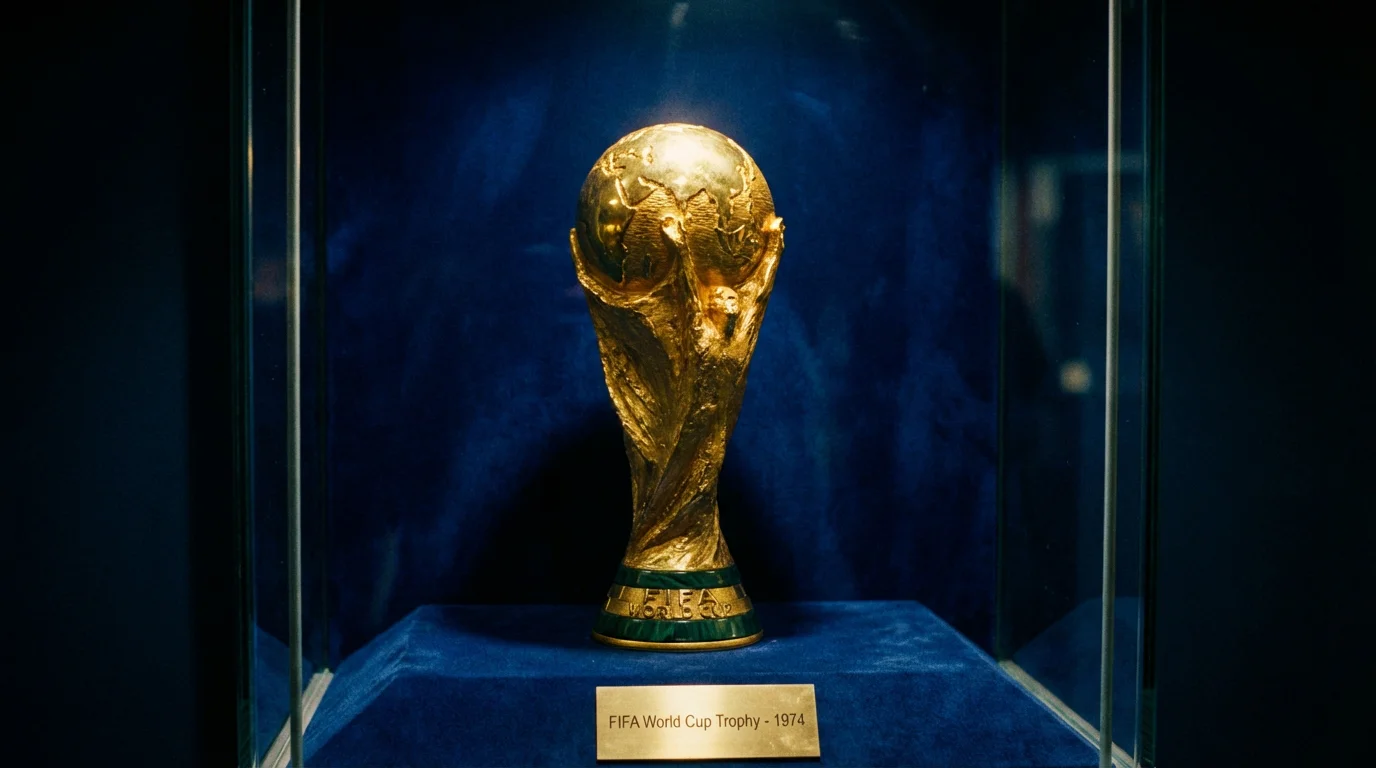
Thirteen different nations have lifted the FIFA World Cup trophy. Brazil have done it five times, Germany and Italy four each, Argentina three, France and Uruguay two apiece. England, Spain, and the remaining seven winners have each claimed the prize once. These numbers have been carved into football’s collective memory, but the deeper statistical record — the patterns beneath the headlines — is what separates an informed World Cup 2026 punter from someone betting on nostalgia. Twenty-two tournaments across 94 years have generated a dataset large enough to reveal how this competition actually works.
All World Cup Winners: 1930–2022
The first World Cup was held in Uruguay in 1930 with 13 teams and no qualifying rounds. The 2022 edition in Qatar featured 32 teams drawn from 211 FIFA member associations. The tournament has expanded three times — from 16 to 24 teams in 1982, from 24 to 32 in 1998, and now from 32 to 48 in 2026. Each expansion has redistributed competitive balance, and the winner list reflects those shifts.
| Year | Host | Winner | Runner-Up | Final Score | Top Scorer | Goals |
|---|---|---|---|---|---|---|
| 2022 | Qatar | Argentina | France | 3-3 (4-2 pen.) | Kylian Mbappé | 8 |
| 2018 | Russia | France | Croatia | 4-2 | Harry Kane | 6 |
| 2014 | Brazil | Germany | Argentina | 1-0 (a.e.t.) | James Rodríguez | 6 |
| 2010 | South Africa | Spain | Netherlands | 1-0 (a.e.t.) | Thomas Müller | 5 |
| 2006 | Germany | Italy | France | 1-1 (5-3 pen.) | Miroslav Klose | 5 |
| 2002 | South Korea / Japan | Brazil | Germany | 2-0 | Ronaldo | 8 |
| 1998 | France | France | Brazil | 3-0 | Davor Šuker | 6 |
| 1994 | United States | Brazil | Italy | 0-0 (3-2 pen.) | Oleg Salenko / Hristo Stoichkov | 6 |
| 1990 | Italy | Germany | Argentina | 1-0 | Salvatore Schillaci | 6 |
| 1986 | Mexico | Argentina | Germany | 3-2 | Gary Lineker | 6 |
| 1982 | Spain | Italy | Germany | 3-1 | Paolo Rossi | 6 |
| 1978 | Argentina | Argentina | Netherlands | 3-1 (a.e.t.) | Mario Kempes | 6 |
| 1974 | West Germany | West Germany | Netherlands | 2-1 | Grzegorz Lato | 7 |
| 1970 | Mexico | Brazil | Italy | 4-1 | Gerd Müller | 10 |
| 1966 | England | England | West Germany | 4-2 (a.e.t.) | Eusébio | 9 |
| 1962 | Chile | Brazil | Czechoslovakia | 3-1 | Multiple (4 goals each) | 4 |
| 1958 | Sweden | Brazil | Sweden | 5-2 | Just Fontaine | 13 |
| 1954 | Switzerland | West Germany | Hungary | 3-2 | Sándor Kocsis | 11 |
| 1950 | Brazil | Uruguay | Brazil | 2-1 (final group) | Ademir | 8 |
| 1938 | France | Italy | Hungary | 4-2 | Leônidas | 7 |
| 1934 | Italy | Italy | Czechoslovakia | 2-1 (a.e.t.) | Oldřich Nejedlý | 5 |
| 1930 | Uruguay | Uruguay | Argentina | 4-2 | Guillermo Stábile | 8 |
South American teams dominated the first 50 years: Uruguay, Brazil, and Argentina claimed 9 of the first 11 titles. European dominance began in the 1980s and has been the defining trend since, with Italy, Germany, France, and Spain winning eight of the last ten tournaments. Argentina’s 2022 victory interrupted a run of four consecutive European winners — the longest such streak in tournament history. Whether South American resurgence continues at the 2026 tournament or reverts to the European pattern is one of the defining market questions heading into June.
All-Time Records
Just Fontaine scored 13 goals in a single World Cup in 1958. It is the kind of record that will almost certainly never be broken — the modern game’s defensive sophistication and tactical discipline make double-digit goal tallies from a single player extraordinarily unlikely. Mbappé’s eight goals in 2022, the highest since Ronaldo’s eight in 2002, illustrate how the ceiling has lowered. But the 2026 format, with its additional knockout round and potential for eight matches per team instead of seven, could push individual tallies back toward the nine or ten mark if one player’s team reaches the final on a favourable scoring path.
| Record | Holder | Figure | Year(s) |
|---|---|---|---|
| Most goals, career | Miroslav Klose (Germany) | 16 | 2002-2014 |
| Most goals, single tournament | Just Fontaine (France) | 13 | 1958 |
| Most appearances | Lothar Matthäus (Germany) | 25 matches | 1982-1998 |
| Most tournaments played | Antonio Carbajal / Lothar Matthäus / Gianluigi Buffon / Cristiano Ronaldo / Lionel Messi | 5 | Various |
| Youngest goalscorer | Pelé (Brazil) | 17 years, 239 days | 1958 |
| Oldest goalscorer | Roger Milla (Cameroon) | 42 years, 39 days | 1994 |
| Largest victory | Hungary 10-1 El Salvador | 9-goal margin | 1982 |
| Most goals in a match | Austria 7-5 Switzerland | 12 total | 1954 |
| Fastest goal | Hakan Şükür (Turkey) | 11 seconds | 2002 |
| Most titles | Brazil | 5 | 1958, 1962, 1970, 1994, 2002 |
| Most finals | Germany | 8 | Various |
| Most consecutive titles | Italy / Brazil | 2 | 1934-38 / 1958-62 |
Several of these records face realistic challenges at the 2026 World Cup. Cristiano Ronaldo and Lionel Messi could both appear at their sixth tournament, a record that would stand alone in World Cup history. Messi’s participation depends on fitness and Inter Miami’s schedule, while Ronaldo has publicly stated his intent to represent Portugal in what he calls his “final chapter.” Klose’s 16-career-goal record is safe — the nearest active player is Messi with 13 — but the single-tournament scoring record could come under pressure if a prolific forward reaches the final through a bracket that includes weak opposition in the earlier rounds.
The fastest goal record — Hakan Şükür’s 11-second strike in the 2002 third-place match — has survived over two decades and is the kind of statistical anomaly that could stand for another 50 years. But the largest victory margin (Hungary’s 10-1 rout of El Salvador in 1982) is genuinely vulnerable. The 48-team format pits traditional heavyweights against nations making their World Cup debuts: Germany vs Curaçao, Brazil vs Haiti, France vs Iraq. These mismatches could produce margins that approach or exceed the 1982 record, particularly in group-stage dead rubbers where the stronger side has already qualified and can play with freedom. The 2026 tournament adds approximately 40% more group-stage matches to the schedule, mechanically increasing the probability of extreme results at both ends of the scoring distribution.
For punters, these records have direct market relevance. Bookmakers offer prop bets on individual record breaks — “Will any player score five or more goals in a single match?” and “Will any match produce 10 or more total goals?” — and historical frequency data provides a framework for pricing those propositions. Five-goal individual performances have occurred three times in 900+ World Cup matches (a 0.3% probability per match), while ten-goal matches have occurred once. Across 104 matches in 2026, the expected number of five-goal individual performances is 0.3, and the expected number of ten-goal matches is 0.1. The odds on these props should reflect those probabilities — anything shorter than 3.00 for a five-goal individual haul is poor value.
Top Scorers in World Cup History
The all-time top scorer list is a measure of longevity as much as talent. Klose’s 16 goals came across four tournaments and 24 matches. Ronaldo’s 15 came across three tournaments and 19 matches. Pelé’s 12 came across four tournaments but only 14 matches — a goals-per-match ratio (0.86) that no one with more than six goals has come close to since.
| Rank | Player | Country | Goals | Matches | Goals/Match | Tournaments |
|---|---|---|---|---|---|---|
| 1 | Miroslav Klose | Germany | 16 | 24 | 0.67 | 4 (2002-2014) |
| 2 | Ronaldo | Brazil | 15 | 19 | 0.79 | 3 (1998-2006) |
| 3 | Gerd Müller | Germany | 14 | 13 | 1.08 | 2 (1970-1974) |
| 4 | Just Fontaine | France | 13 | 6 | 2.17 | 1 (1958) |
| 5= | Lionel Messi | Argentina | 13 | 26 | 0.50 | 5 (2006-2022) |
| 5= | Pelé | Brazil | 12 | 14 | 0.86 | 4 (1958-1970) |
| 7 | Kylian Mbappé | France | 12 | 14 | 0.86 | 2 (2018-2022) |
| 8 | Jürgen Klinsmann | Germany | 11 | 17 | 0.65 | 3 (1990-1998) |
| 9= | Sándor Kocsis | Hungary | 11 | 5 | 2.20 | 1 (1954) |
| 10 | Gabriel Batistuta | Argentina | 10 | 12 | 0.83 | 3 (1994-2002) |
| 11 | Teófilo Cubillas | Peru | 10 | 13 | 0.77 | 3 (1970-1982) |
| 12 | Thomas Müller | Germany | 10 | 19 | 0.53 | 4 (2010-2022) |
| 13 | Grzegorz Lato | Poland | 10 | 20 | 0.50 | 3 (1974-1982) |
| 14 | Gary Lineker | England | 10 | 12 | 0.83 | 2 (1986-1990) |
| 15 | Helmut Rahn | Germany | 10 | 10 | 1.00 | 2 (1954-1958) |
Mbappé enters the 2026 World Cup on 12 career goals from just 14 matches — a ratio of 0.86 that matches Pelé’s career rate. If France reach the semi-finals and Mbappé maintains even a modest scoring pace, he could finish the tournament with 15 or 16 goals, tying or breaking Klose’s all-time record at age 27. That prospect alone makes Mbappé’s Golden Boot odds worth monitoring closely throughout June and July.
The dominance of European and South American players on this list is striking. No player from Africa, Asia, Oceania, or CONCACAF appears in the top 15. The highest-scoring African player in World Cup history is Asamoah Gyan (Ghana) with six goals. The highest-scoring Asian player is Son Heung-min (South Korea) with three. This imbalance is partly a function of tournament depth — teams from these confederations historically exit earlier, limiting their players’ opportunities — and partly a reflection of the talent pipeline that has favoured European and South American football systems for decades.
Host Nation Performance Data
I track host performance data because it directly informs how I price the three 2026 host nations — USA, Mexico, and Canada — in outright and group markets. The data across 22 tournaments tells a consistent story: hosts outperform their pre-tournament ranking more often than not.
| Metric | Host Nations (all time) | Non-Host Nations (all time) |
|---|---|---|
| Group stage exit rate | 9% (2 of 22) | 52% |
| Reached quarter-finals or better | 77% (17 of 22) | 25% |
| Won tournament | 27% (6 of 22) | 4% |
| Average goals per match | 2.1 | 1.3 |
| Win rate in group stage | 64% | 35% |
Six of 22 World Cup hosts have won the tournament: Uruguay (1930), Italy (1934), England (1966), West Germany (1974), Argentina (1978), and France (1998). Only two hosts — South Africa (2010) and Qatar (2022) — failed to advance from the group stage. The 77% rate of reaching at least the quarter-finals is the most relevant statistic for 2026: it suggests the USA, with their Group D draw and home stadiums, have a strong probability of reaching the knockout stage and competing through the Round of 16 at minimum.
The triple-host format in 2026 dilutes the advantage somewhat. Mexico play only their group matches at home (Estadio Azteca, Monterrey, Guadalajara) before the knockout stage shifts entirely to US venues. Canada similarly play group matches at BMO Field and BC Place before losing home advantage. Only the USA maintain host-venue advantage throughout the knockout phase, which makes the American side the primary beneficiary of the historical host premium.
Performance by Confederation
UEFA and CONMEBOL have won every World Cup in history. That is not a misstatement or a caveat — in 22 tournaments across 94 years, every winner has come from one of those two confederations. The question for 2026 is whether the expansion to 48 teams, which gives CAF, AFC, CONCACAF, and OFC more representatives than ever, will erode that dominance or reinforce it.
| Confederation | 2026 Teams | Best-Ever Finish | Semi-Finalists (all time) | Group Exit Rate (2002-2022) |
|---|---|---|---|---|
| UEFA (Europe) | 16 | Winners (12 times) | Multiple | 26% |
| CONMEBOL (South America) | 6 | Winners (10 times) | Multiple | 30% |
| CAF (Africa) | 9 | Quarter-finals (Cameroon 1990, Senegal 2002, Ghana 2010, Morocco 2022) | Morocco 2022 (4th) | 60% |
| AFC (Asia) | 8 | 4th (South Korea 2002) | South Korea 2002 | 64% |
| CONCACAF (North/Central America, Caribbean) | 6 | Quarter-finals (USA 2002, Mexico multiple) | 0 | 48% |
| OFC (Oceania) | 1 | Group stage (NZ 2010, Australia 2006 under OFC) | 0 | 100% |
The data makes uncomfortable reading for anyone hoping for a breakthrough from outside Europe or South America. CAF’s best showing — Morocco’s fourth-place finish in 2022 — was historic but has not yet translated into a sustained pattern. AFC’s best came 24 years ago in a co-hosted tournament with the associated home advantage. CONCACAF has never produced a semi-finalist. OFC’s sole representative at the 2026 World Cup, New Zealand, carries a group-stage exit rate of 100% across their two previous appearances (1982 and 2010).
But the 48-team format creates structural opportunities for non-traditional confederations. Nine African teams at a single World Cup is unprecedented. Eight Asian teams is unprecedented. With eight best third-placed teams qualifying alongside the top two in each group, the barrier to reaching the knockout stage has never been lower. My model projects that five to seven CAF and AFC teams will reach the Round of 32 in 2026, compared to a combined three to four at the 2022 tournament. Whether any of them break through to the quarter-finals or beyond depends on bracket draws and matchup specifics rather than confederation-wide patterns.
The trend worth watching most closely is African football’s trajectory. Morocco’s 2022 semi-final run was built on a European-trained squad — most of their starting eleven played in La Liga, Ligue 1, or Serie A — and that model is now replicated across multiple African federations. Nigeria, Senegal, Côte d’Ivoire, and Egypt all field squads where the majority of key players compete in Europe’s top five leagues. The infrastructure gap between African and European football remains wide at the grassroots level, but at the elite level the talent pipeline has converged. If an African nation is going to win a World Cup in the next 20 years, the groundwork is being laid now, and the 2026 tournament will be the first real test of whether the expanded format accelerates that process.
The 48-Team Era: What Historical Data Suggests
The last time the World Cup expanded was in 1998, from 24 to 32 teams. What happened? Goals per match increased marginally (from 2.71 in 1994 to 2.67 in 1998), the number of blowout results (three-goal margins or greater) rose by 22%, and two debut nations — Croatia and Japan — reached the knockout stage. Croatia went all the way to third place. The expansion was initially criticised as diluting quality, but the data shows it broadened competitive scope without significantly lowering the overall standard of play at the tournament’s sharp end.
The 2026 expansion from 32 to 48 is larger in absolute terms (16 additional teams versus 8 in 1998), and the format change is more radical: 12 groups of four instead of 8, with a Round of 32 inserted before the Round of 16. Historical modelling suggests several probable outcomes.
First, goals per match in the group stage will likely increase. The 2026 groups contain more mismatches than any previous tournament — Germany vs Curaçao, Brazil vs Haiti, France vs Iraq, Argentina vs Jordan — and these fixtures historically produce 3+ goals. My projection for overall goals per match in 2026 is 2.85, up from 2.67 in 2022. Second, the knockout stage will be longer and more attritional, with the Round of 32 adding a match round that favours organised defensive sides over technically superior but less disciplined teams. Third, the “best third place” qualification route will produce at least one surprise semi-finalist — a team that finishes third in their group but catches momentum in the knockout rounds. Portugal in Euro 2016, who won the entire tournament after finishing third in their group, is the precedent. For a detailed look at how New Zealand’s World Cup history fits within this evolving landscape, the archive covers every All Whites appearance in full.
