
Argentina at World Cup 2026: Champions' Odds & Squad Data — KICKOFF26
 Available in US
Loading...
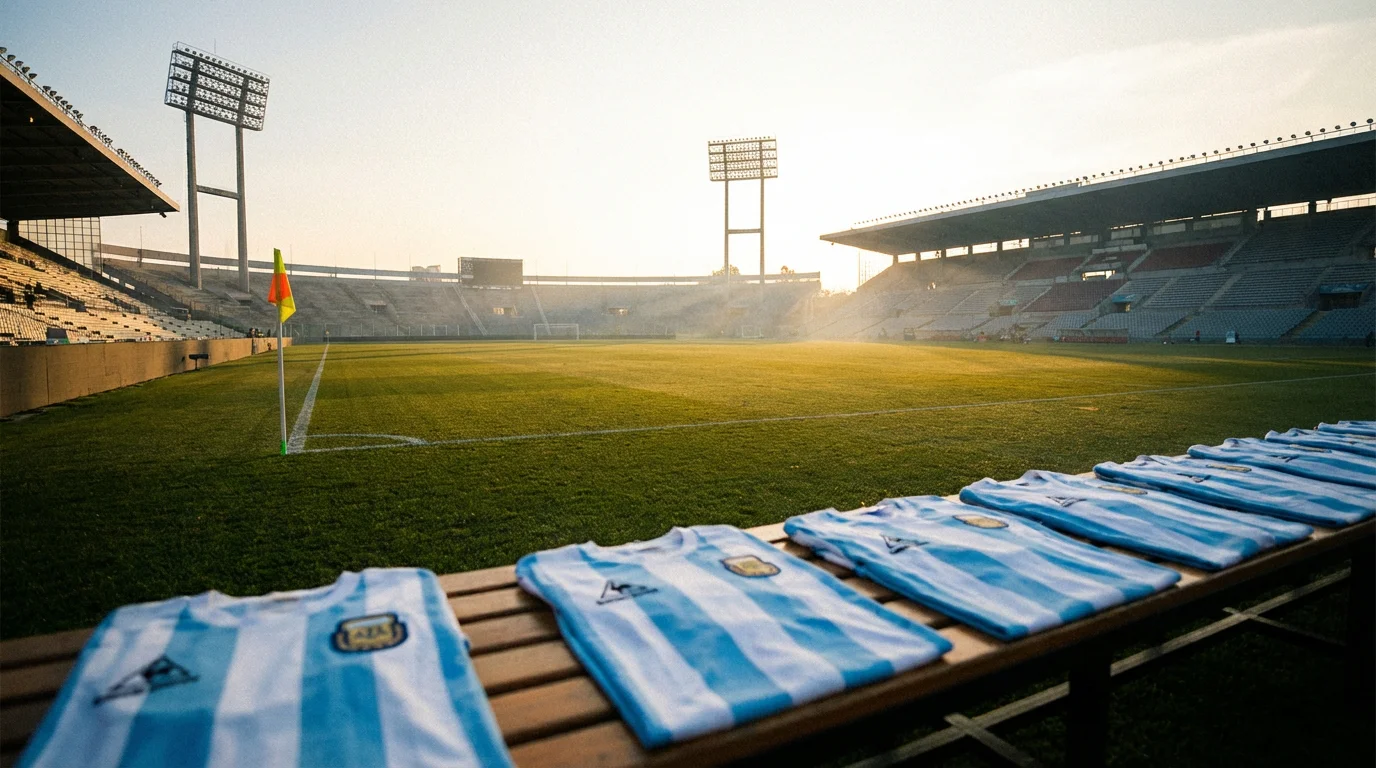
Can they do it again? This question echoes through every conversation about Argentina’s 2026 World Cup campaign. The defending champions arrive in North America with the weight of expectations that only tournament winners comprehend — the demand to repeat excellence that defies historical patterns and statistical probability. Since Brazil in 1962, no nation has successfully defended the World Cup. Argentina intends to become the first in over six decades.
The 2022 triumph in Qatar transformed Lionel Messi from the greatest player never to win football’s ultimate prize into an immortal whose legacy debates ended permanently. At 38 years old in June 2026, Messi approaches what is almost certainly his final World Cup with diminished physical capacity but undimmed competitive fire. His MLS statistics indicate a player operating at elite creative levels despite reduced sprint distances and pressing contributions. Whether those numbers translate to World Cup knockout football remains the central uncertainty around Argentina’s title defence.
The Data Profile: Reigning Champions by the Numbers
Argentina’s third-place FIFA ranking understates their competitive position. The reigning World Cup and Copa América champions possess tournament football credentials that no other nation can match — consecutive major trophy victories that demonstrate the precise qualities required for knockout competition. Their 2022 World Cup expected goals data (12.7 xG created, 8.2 xG conceded across seven matches) revealed a squad that dominated possession phases while maintaining defensive organisation that frustrated superior-quality opponents.
| Metric | Data |
|---|---|
| FIFA Ranking | 3rd |
| World Cup Titles | 3 (1978, 1986, 2022) |
| World Cup Appearances | 19 (including 2026) |
| World Cup Record (All-Time) | P88 W47 D17 L24 GF156 GA100 |
| Head Coach | Lionel Scaloni |
| Captain | Lionel Messi |
| Group J Opponents | Algeria, Austria, Jordan |
| Group Winner Odds | 1.15 |
| Tournament Winner Odds | 5.00 |
The historical record reinforces Argentina’s pedigree. Nineteen World Cup appearances include three victories — 1978 on home soil, 1986 with Maradona’s transcendent brilliance, and 2022 in Qatar with Messi finally claiming the trophy that had eluded him through four previous tournaments. No South American nation has participated in more World Cups. No South American nation has won more World Cups. The experience of tournament football saturates Argentine football culture in ways that smaller footballing nations cannot replicate.
Lionel Scaloni’s coaching tenure has produced results that surpass his relatively modest playing career. Since taking charge in 2018, Scaloni has compiled a record of 52 wins, 11 draws, and just 7 defeats across all competitions. His tactical flexibility — adjusting formations and personnel to neutralise specific opponents — proved decisive in the 2022 knockout stages. The continuity of his tenure provides Argentina with institutional stability that many competitors lack as they approach 2026 with newer coaching regimes still establishing philosophies.
Qualification: CONMEBOL Campaign Data
South American World Cup qualification operates through a single round-robin league — 18 matches against nine opponents over three years of competition. Argentina finished second in the CONMEBOL standings behind Brazil, accumulating 39 points from their 18 matches with 11 wins, 6 draws, and just 1 defeat. That solitary loss came against Colombia in Barranquilla, the notoriously hostile altitude venue where South American qualification dreams frequently expire.
The qualification statistics reveal a squad that performed precisely to expectations without the dramatic fluctuations that troubled rivals. Argentina scored 33 goals (1.83 per match) while conceding 14 (0.78 per match) — a goal differential that reflected both attacking potency and defensive discipline. Julián Álvarez emerged as the leading scorer with 8 goals from qualification, while Messi contributed 6 goals and 9 assists despite playing reduced minutes compared to younger teammates.
The away record throughout qualification demonstrated Argentina’s capacity to win difficult matches in inhospitable environments. Victories in Bolivia (3-0), Ecuador (1-0), and Peru (1-0) required the psychological resilience that separates genuine contenders from pretenders. Scaloni rotated his squad strategically, preserving Messi for crucial fixtures while developing depth options that proved their value when injuries and suspensions required adjustments.
Argentina’s path through qualification included tactical evolution that will inform their World Cup approach. The 4-3-3 system that won in Qatar gradually incorporated variations — occasional 3-4-3 shapes when chasing matches, more conservative 4-2-3-1 setups against dangerous counter-attacking opponents. This flexibility demonstrated Scaloni’s willingness to adjust rather than dogmatically pursuing a single approach regardless of opponent characteristics.
Squad Analysis: Beyond Messi
The succession question looms over Argentina despite their defending champion status. Messi cannot continue forever, and the squad’s psychological dependence on their captain creates vulnerability that opponents will attempt to exploit. The 2022 final against France demonstrated both Messi’s brilliance and his team’s capacity to function when he operates at reduced physical intensity — a template that 2026 will likely replicate.
Julián Álvarez has established himself as Argentina’s attacking future. The Manchester City forward scored four goals at the 2022 World Cup and followed with consistent performances in qualification that confirmed his readiness for primary striking responsibility. At 26, Álvarez combines the physical attributes required for tournament football — pace, aerial ability, pressing stamina — with technical quality refined through Guardiola’s demanding coaching. His partnership with Messi functions through complementary movement: Álvarez makes runs behind defences that create space for Messi to operate in deeper zones.
Enzo Fernández represents Argentina’s midfield heartbeat. The Chelsea midfielder, still only 25, provides ball progression and defensive stability that anchors Scaloni’s tactical systems. His passing accuracy of 89% during qualification reflected controlled distribution rather than risky creativity — the decision-making that allows Messi and Álvarez to receive possession in advantageous positions. Fernández’s trajectory since breaking through at the 2022 World Cup (winning the Young Player award) suggests a future captain once Messi’s era concludes.
Alexis Mac Allister’s evolution at Liverpool has added another world-class option in central midfield. The former Brighton player’s adaptation to Jürgen Klopp’s intense tactical demands improved his defensive contribution while maintaining the creative passing that distinguished his Premier League breakthrough. Mac Allister and Fernández can operate as a double pivot or as the base of a midfield three, providing Scaloni with flexibility that few national team coaches possess.
The defensive unit remains largely unchanged from 2022. Nicolás Otamendi, now 38, continues as the experienced centre-back alongside younger partners like Cristian Romero or Lisandro Martínez. Otamendi’s longevity defies conventional expectations about defensive decline — his qualification performances demonstrated leadership and positional intelligence that compensate for reduced recovery speed. Emiliano Martínez remains Argentina’s goalkeeper, his penalty-saving heroics in Qatar now part of World Cup folklore. Martínez’s shot-stopping at Aston Villa has been exceptional, and his psychological games with opposing penalty takers provide marginal advantages in knockout situations.
The wide positions offer Scaloni multiple options with distinct profiles. Ángel Di María retired from international football after the 2024 Copa América, but his departure created opportunity for Nicolás González (Juventus) and Alejandro Garnacho (Manchester United). Garnacho’s emergence as a genuine Premier League star provides Argentina with dynamic dribbling capability that replaces Di María’s experience with youthful exuberance. At 21, Garnacho enters his first World Cup with the confidence that United’s difficult seasons somehow failed to diminish.
The defensive depth deserves attention beyond the starting eleven. Nahuel Molina provides reliable cover at right-back, while Marcos Acuña offers left-sided options when Nicolás Tagliafico requires rest. The centre-back pool includes Germán Pezzella and Leonardo Balerdi alongside the established partnership, ensuring that rotation or injury does not fundamentally compromise Argentine defensive organisation. This depth proved crucial during qualification when various starting players missed matches through suspension or fitness management.
Lautaro Martínez represents Argentina’s alternative striking profile to Álvarez. The Inter Milan forward brings different qualities — more clinical finishing in the box, stronger hold-up play, less mobile pressing contribution — that allow Scaloni to adjust attacking approaches based on opponent characteristics. Against deep-defending teams, Lautaro’s penalty box movement might prove more effective than Álvarez’s running channels. Against high-pressing opponents, Álvarez’s work rate becomes more valuable. The luxury of choice between two elite strikers separates Argentina from most World Cup squads.
Group J: Argentina’s Draw Analysis
The group stage draw provided Argentina with the least challenging section available. Algeria, Austria, and Jordan collectively present minimal obstacles to qualification — a fortunate allocation that allows the defending champions to preserve energy for knockout rounds where genuine tests await. Argentina’s odds of 1.15 to win Group J imply 87% probability, leaving 13% distributed among three opponents whose realistic ceiling involves claiming a draw.
Algeria represents the strongest group opponent based on FIFA ranking (31st) and African Cup of Nations performance. The Desert Foxes’ counter-attacking capabilities could trouble Argentina if the match becomes open, though Scaloni’s tactical discipline should prevent the circumstances that allow such transitions. Algeria’s qualification from a difficult CAF section demonstrates genuine competitiveness, but the gulf between CAF’s standard and Argentina’s quality remains substantial.
Austria brings European tactical organisation and Bundesliga-quality personnel to Group J. Their qualification campaign included impressive results against Belgium (a draw that proved significant) and consistent performances that reflected Ralf Rangnick’s sophisticated pressing system. The Austria match will likely prove Argentina’s most tactically demanding group fixture — requiring concentration and physical intensity that might otherwise be conserved for later rounds.
Jordan completes the group as the clear underdog among underdogs. Their remarkable Asian Cup performances in 2024 (runners-up finish) demonstrated competitive capacity, but World Cup football represents a different level entirely. Jordan’s defensive organisation may limit Argentine scoring, but the probability of a Jordanian result approaches the negligible.
| Date (ET) | Match | Venue |
|---|---|---|
| 14 June, 18:00 | Argentina vs Algeria | Hard Rock Stadium, Miami |
| 20 June, 15:00 | Argentina vs Jordan | AT&T Stadium, Dallas |
| 25 June, 21:00 | Austria vs Argentina | Hard Rock Stadium, Miami |
The Miami-based fixtures provide Argentina with climate familiarity (humidity levels similar to Buenos Aires summers) and substantial diaspora support. The Argentine community in South Florida numbers in the hundreds of thousands, guaranteeing passionate atmospheres that approximate home advantage. Dallas offers similar demographic benefits given Texas’s large Latin American population. Argentina’s “home” advantage throughout the United States extends beyond mere geography to cultural presence that smaller nations cannot replicate.
The group stage serves primarily as preparation for knockout football rather than genuine competitive examination. Scaloni will use these three matches to finalise tactical approaches, manage workloads for veteran players, and integrate bench options who may become necessary if injuries accumulate. The reduced stakes create both opportunity (experimentation without consequence) and risk (complacency that allows opponents to steal results). Argentina’s professionalism throughout qualification suggests the latter concern is manageable.
Argentina Odds: Outright and Market Data
The betting markets have installed Argentina as tournament favourites at 5.00 — odds that imply 20% probability of defending their title. This pricing reflects both the quality of their squad and the historical difficulty of consecutive World Cup victories. No nation since Brazil 60 years ago has achieved back-to-back titles, suggesting that market confidence in Argentina may exceed what historical patterns support.
Value assessment requires distinguishing between Argentina’s genuine quality and inflated pricing driven by 2022 nostalgia. The squad has aged since Qatar — Messi most obviously, but also Otamendi, Di María (now retired), and Emiliano Martínez. The core creative unit remains elite, but the physical demands of seven World Cup matches across 30 days create cumulative stress that favours younger squads. France (6.50) and England (8.00) both offer younger star players and comparable squad depth, potentially representing better value than the defending champions.
| Market | Argentina Odds | Implied Probability |
|---|---|---|
| Tournament Winner | 5.00 | 20.0% |
| Reach Final | 2.75 | 36.4% |
| Reach Semifinals | 1.80 | 55.6% |
| Win Group J | 1.15 | 87.0% |
| Top Scorer: Álvarez | 15.00 | 6.7% |
| Top Scorer: Messi | 26.00 | 3.8% |
The reach semifinal odds at 1.80 appear closer to fair value. Argentina’s path from Group J likely involves a Round of 32 match against a third-placed team followed by a Round of 16 fixture against the Group I runner-up (potentially Norway or Senegal). Neither round presents insurmountable obstacles, making semifinal qualification the realistic baseline expectation for defending champions. Anything less would represent significant underperformance.
Julián Álvarez’s top scorer odds at 15.00 merit consideration given his consistent international goal record and Argentina’s favourable fixtures through the group stage. Three matches against Algeria, Jordan, and Austria could yield four to six goals for the primary striker if Argentina performs to expectations. The Golden Boot typically requires six or seven goals — achievable if Álvarez maintains starting status through knockout rounds where Argentina expects to progress.
Messi’s top scorer odds at 26.00 reflect his age-related reduced playing time rather than diminished ability to find the net. His 2022 World Cup goal tally of seven demonstrated elite finishing when opportunities materialise. The longer odds represent realistic assessment of minutes played rather than capability — making this an interesting speculative option for punters who believe Messi will feature prominently throughout the tournament despite load management expectations.
The market for Argentina to exit before the quarter-finals prices around 6.00 — implying approximately 17% probability of early elimination. This would represent catastrophic underperformance given squad quality and draw fortune, but World Cup history includes sufficient defending champion collapses (France 2002, Spain 2014, Germany 2018) to justify such prices existing. For punters seeking Argentine underperformance plays, this market offers defined risk against improbable but not impossible outcomes.
World Cup Pedigree: The Data Behind Three Stars
Those three stars on Argentina’s jersey carry more weight than mere decoration. Each represents a tournament victory that defined an era of football — 1978 in Buenos Aires amid political complexity, 1986 in Mexico with Maradona’s singular brilliance, and 2022 in Qatar with Messi finally completing his legacy. The cumulative experience of 19 World Cup appearances has created institutional knowledge that permeates Argentine football from youth academies to senior national team tactics.
The 2022 victory statistics bear examination for what they reveal about this squad’s tournament mentality. Argentina conceded first against Saudi Arabia in the group stage opener, then recovered to reach the final — a psychological resilience that separates champions from pretenders. They won all four knockout matches (Australia, Netherlands, Croatia, France) through different methods: controlled domination, penalty shootouts, and a final that required extra time after surrendering a two-goal lead. The variety of pathways to victory demonstrated adaptability that coaching alone cannot instil.
Messi’s individual 2022 statistics merit detailed attention: 7 goals, 3 assists, 6 Player of the Match awards across 7 appearances. Those numbers placed him among the greatest individual World Cup performances in tournament history, alongside Pelé’s 1970 exhibition and Maradona’s 1986 one-man show. At 35, Messi performed at levels that his younger iterations had never achieved in World Cup competition. The question for 2026 is whether 38-year-old Messi retains sufficient physical capacity to replicate or approximate that contribution.
Argentina’s World Cup record across 88 matches (47 wins, 17 draws, 24 losses) places them alongside Germany and Brazil as the most consistently successful nations in tournament history. The goal differential of +56 (156 scored, 100 conceded) reflects attacking traditions that have characterised Argentine football since the tactical innovations of the 1970s. This heritage creates expectations — both from supporters and within the squad itself — that tournament football demands excellence rather than mere participation.
Can Argentina Defend Their Title?
History says no. Statistical probability says no. The accumulated weight of World Cup precedent — 92 years of tournaments without consecutive champions — says no. And yet. Argentina possesses qualities that previous defending champions lacked: a squad nucleus that has remained together across multiple tournaments, a coaching staff with proven knockout-round competence, and psychological confidence derived from already achieving the ultimate goal.
The path to a successful defence requires navigating approximately seven matches across a month of competition. Argentina should win Group J without significant exertion, preserving Messi for knockout rounds where his influence becomes decisive. The Round of 32 and Round of 16 should present manageable obstacles given likely opponents. The quarter-finals and beyond become genuinely unpredictable — moments where individual brilliance or collective collapse determines outcomes that no model can reliably forecast.
My assessment: Argentina reaches the semifinals as expected, then faces the examination that determines whether this golden generation achieves immortality or merely excellence. The opponents at that stage — likely France, Germany, or England — possess the quality to eliminate Argentina regardless of historical pedigree. A semifinal exit would represent honourable defence of the title. A final appearance would confirm this squad’s place among the greatest World Cup teams. Victory would achieve something unprecedented.
The tournament structure favours Argentina’s chances more than raw probability suggests. Their likely knockout path avoids Brazil until a potential final, and the draw’s geography places their matches in cities with substantial Argentine support. If Messi remains healthy through the group stage, arriving at knockout rounds with full fitness and competitive sharpness, Argentina’s ceiling includes genuine trophy contention. The floor involves quarter-final elimination if key players underperform or injuries strike at inopportune moments.
For New Zealand punters, Argentina represents the tournament’s clearest favourite and the benchmark against which all other contenders should be measured. The World Cup 2026 winner odds reflect Argentina’s status without overpromising value. The deeper market analysis involves assessing whether their prices represent genuine opportunity or nostalgia-inflated risk. I lean toward the latter — Argentina deserves respect without demanding backing at current odds.
