
Spain Win World Cup 2026: 1-0 Victory Over Argentina in Extra Time
 Available in US
Loading...
Key Numbers
| Metric | Value |
|---|---|
| Final score | Spain 1-0 Argentina (AET) |
| Winning goal | Ferran Torres 106′ |
| Attendance | 80,663 (MetLife Stadium, New Jersey) |
| Spain’s title count | 2 (2010, 2026) |
| Argentina’s quest | Failed to defend title (would have been first since Brazil 1958/62) |
| Match referee | Slavko Vinčič (Slovenia) |
| Goals conceded by Spain (tournament) | 1 in 8 matches — fewest ever by a World Cup champion |
| Spain’s unbeaten run | 38 matches — new world record |
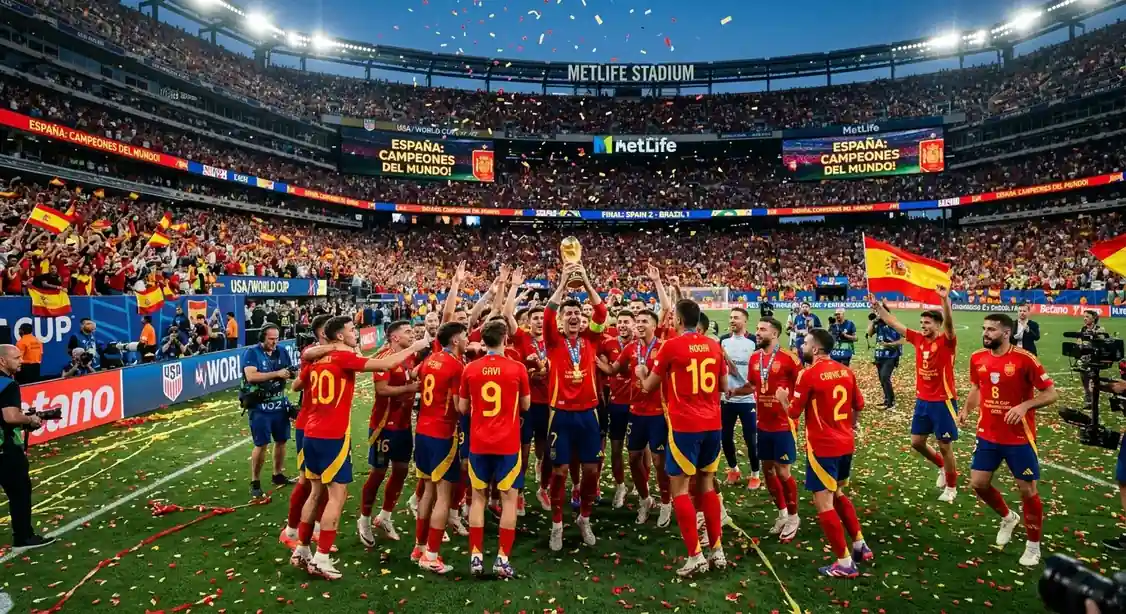
Spain are world champions for the second time, defeating holders Argentina 1-0 in extra time at MetLife Stadium on 19 July 2026. Substitute Ferran Torres scored the decisive goal 106 minutes into the final, 39 seconds after the start of the second period of extra time, to seal Spain’s first World Cup title since 2010 and complete a Euro 2024 / World Cup 2026 double.
Match Summary: Deadlock Broken in Extra Time
The final was scoreless through 90 minutes before Torres’ intervention decided the contest. Spain dominated possession and chances — Argentina failed to register a single shot on target across the full 120 minutes — but Argentina’s defensive resilience, led by goalkeeper Emiliano Martínez’s 11 saves (a World Cup final record), kept the score level into extra time.
The breakthrough arrived when Pedro Porro delivered a cross from the right flank to the far post. Substitute Nico Williams rose above Argentina’s Nahuel Molina to head the ball across goal, where Torres — who had entered the match on 62 minutes in place of Mikel Oyarzabal — struck first-time with his left foot past Martínez.
| Phase | Score | Key events |
|---|---|---|
| 0–90′ | 0-0 | Argentina 0 shots on target; Martínez 11 saves |
| 91–105′ | 0-0 | First period of extra time scoreless |
| 106′ | 1-0 Spain | Ferran Torres (assist: Nico Williams header from Porro cross) |
| Full-time | Spain 1-0 (AET) | Spain win second World Cup title |
Argentina played the final 30 minutes and all of extra time with 10 men after Enzo Fernández was sent off for a second yellow card in the 90+3rd minute (foul on Pau Cubarsí).
Historic Achievement: Spain’s Double and World Records
Spain’s victory completes a historic double: holders of both Euro 2024 and World Cup 2026 simultaneously. Combined with Spain’s women’s team winning the 2023 Women’s World Cup, Spain become the first nation in history to hold both the men’s and women’s World Cups at the same time.
Spain’s defensive record at this tournament is unmatched in World Cup history. They conceded just one goal across eight matches (seven clean sheets), the fewest ever by a world champion. Their 38-match unbeaten run — extended by this final — sets a new all-time international record, surpassing Italy’s previous mark of 37.
Spain won all eight matches at the tournament (7 in regulation, 1 in extra time) to lift the trophy without a single loss or draw.
Final Standings and Prize Money
| Position | Nation | Route to finish |
|---|---|---|
| 🥇 1st | Spain | Won final 1-0 (AET) vs Argentina |
| 🥈 2nd | Argentina | Lost final |
| 🥉 3rd | England | Won third-place 6-4 vs France (18 Jul) |
| 4th | France | Lost third-place |
England claimed third place in a 10-goal thriller against France on 18 July, winning 6-4 in the highest-scoring World Cup match since 1982. The third-place result marks England’s best World Cup performance since their 1966 victory on home soil.
Path to the Title: Spain’s Eight Victories
Spain’s road to the trophy:
| Round | Opponent | Result |
|---|---|---|
| Group H | (3 matches) | 7 points, 1st in Group H |
| Round of 32 | Austria | 3-0 |
| Round of 16 | Portugal | 1-0 |
| Quarter-final | Belgium | 2-1 |
| Semi-final | France | 2-0 |
| Final | Argentina | 1-0 (AET) |
Spain topped Group H with seven points before eliminating Austria, Portugal, Belgium, France and Argentina in knockout football. They scored 12 goals and conceded one (a group-stage goal). Spain kept six consecutive clean sheets from the round of 32 through to the final’s 105th minute, when they had already secured victory.
Tournament Legacy: First 48-Team World Cup
World Cup 2026, jointly hosted by the United States, Canada and Mexico, was the first edition expanded to 48 teams and 104 matches. The tournament set records for total attendance (6.81 million — an all-time high, roughly double the 1994 record) and total goals (308 in 104 matches, averaging 2.96 per match).
The final at MetLife Stadium drew 80,663 spectators. The tournament also featured the first-ever World Cup final halftime show, curated by Chris Martin and featuring performers including BTS, Shakira, Madonna, Justin Bieber and Burna Boy.
What It Means for New Zealand Fans
Spain entered the final as favourites with pre-match odds of 1.67 (FanDuel) to lift the trophy, and those backing Spain at that price saw a return. Argentina were priced at 2.30 before kick-off. However, the 90-minute 1X2 market settled as a draw (0-0 after regulation time), while the "to lift trophy" market (including extra time and penalties) settled on Spain.
For New Zealand punters who backed Spain to win the tournament at earlier prices — Spain were available around 7.00–9.00 during the group stage — the payout was significantly higher. A $100 NZD bet on Spain at 8.00 during the group stage would have returned $800 NZD.
The tournament’s conclusion brings an end to New Zealand’s campaign, which ended in the group stage after finishing fourth in Group G with one point from three matches. Coverage of the All Whites’ World Cup 2026 journey is available in our teams section.
What the Numbers Show
Spain’s data-driven excellence defined this tournament:
- Defensive solidity: 1 goal conceded in 8 matches (7 clean sheets)
- Possession control: Dominated final with 0 shots on target conceded
- Substitutes’ impact: Both goal contributors (Ferran Torres, Nico Williams) came off the bench
- Historical context: First nation to hold Euro + World Cup + Women’s World Cup simultaneously
- Record-breaking: 38-match unbeaten run (new world record)
Argentina fell short of becoming the first nation to defend a World Cup title since Brazil in 1958 and 1962. Lionel Messi, playing in what is widely reported as his final World Cup at age 39, finished the tournament with 8 goals and 4 assists but left without the trophy he lifted in 2022.
The individual awards — including the Golden Ball (best player), Golden Boot (top scorer), and Golden Glove (best goalkeeper) — were announced following the final. Spain dominated the team-based awards, with only the Golden Boot going outside the squad. Full awards coverage is available in our dedicated awards analysis.
Spain’s victory confirms their status as the dominant international side of the mid-2020s. Luis de la Fuente’s squad, built on a core of young talent including 19-year-old Lamine Yamal and 19-year-old Pau Cubarsí, have added World Cup glory to their European Championship triumph just 12 months prior.
The next World Cup is scheduled for 2030, with a joint bid from Spain, Portugal, Morocco, Argentina, Paraguay and Uruguay set to host the centenary edition.
